Before your first mint tea in Marrakech, it helps to understand how money in Morocco works. Morocco has ATMs in every city and card machines in most hotels, yet cash still runs daily life: taxis, souks, small cafés and mountain villages. After 20 years of guiding travellers from the medinas to the Sahara, we hear the same questions every week. How much cash should I carry? Can I pay by card? How much should I tip? This guide answers them in plain words.
The Moroccan dirham at a glance
Morocco's currency is the Moroccan dirham (MAD). On price tags you will often see "DH" or "dhs".
- Banknotes: 20, 50, 100 and 200 dirhams.
- Coins: 1, 2, 5 and 10 dirhams, plus small centime coins.
- Exchange rate: in 2026, one euro has been worth roughly 10.6 to 10.9 dirhams, and one US dollar a little over 9 dirhams. Rates move, so check on the day you travel.
The dirham is a closed currency. You usually cannot buy it at home, and the amount of dirhams you may carry in or out of the country is limited (currently 2,000 dirhams per person). Plan to get your dirhams after you land.
A local tip: in traditional markets, some older vendors still count in "rials", an old unit where 20 rials equal 1 dirham. If a price sounds impossibly high, simply ask: "Dirham?"
How much cash do you need in Morocco?
Cash is still king, especially outside the big cities. You will need it for:
- Petit taxis and small local transport
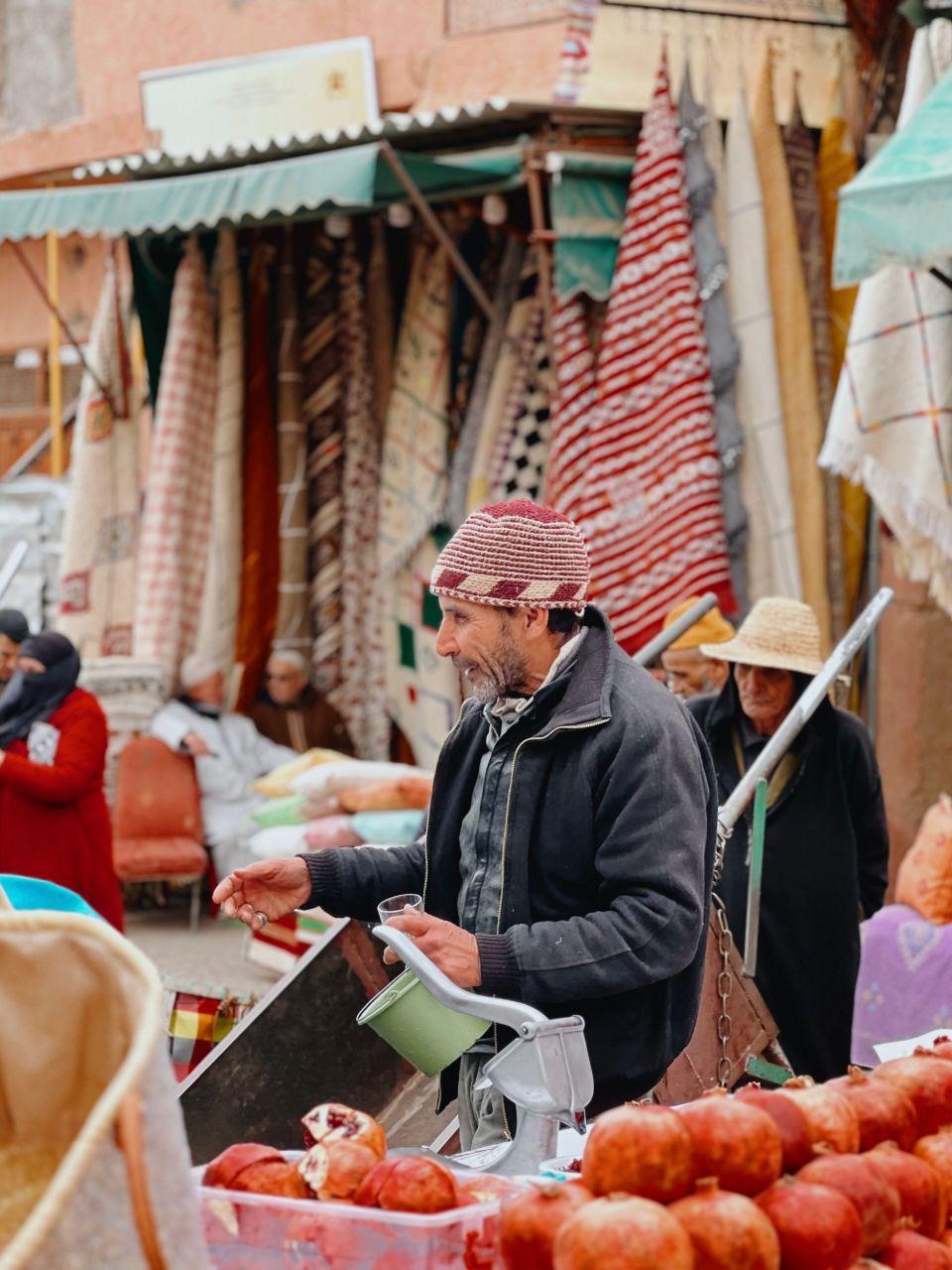
- Souk shopping and street food
- Small cafés and family restaurants
- Drinks and extras at desert camps and mountain guesthouses
- Tips for guides, drivers, porters and camp staff
When your hotels and transport are already paid, many of our guests find that 300 to 500 dirhams per person per day covers meals out, small purchases and tips. If you plan big souvenir purchases, like a carpet, add more or ask the shop about card payment.
Always keep small notes and coins. Many shops and taxis struggle to change a 200-dirham note, especially in the morning.
ATMs in Morocco: what to expect
You will find ATMs in every city and in most towns. They become rare in the mountains and the desert, so withdraw what you need in Marrakech, Ouarzazate or Tinghir before heading to Merzouga.
- Withdrawal limit: most machines allow about 2,000 dirhams per withdrawal. Some allow more. You can usually repeat the withdrawal if your own bank allows it.
- Fees: Moroccan banks usually charge a fixed fee for foreign cards (often around 35 dirhams), and your own bank may add its fee. Withdraw larger amounts less often to save money.
- Choose dirhams: if the screen offers to convert the amount into your home currency, decline and choose MAD. The conversion offered by the machine is usually more expensive.
- Use bank branches: prefer ATMs attached to a bank, during opening hours. If the machine keeps your card, staff can help you get it back.
Before you fly, tell your bank that you are travelling to Morocco, so your card is not blocked for unusual activity.
Paying by card in Morocco
Visa and Mastercard are the most widely accepted cards. You can usually pay by card at:
- Hotels, riads and larger restaurants
- Supermarkets and shopping malls
- Fuel stations in cities
- Larger shops with fixed prices
Cards are rarely accepted in small shops, taxis, local cafés, villages and the desert. Some medina shops accept cards for large purchases, sometimes with a small surcharge, so ask before you start bargaining.
When the card machine asks, always pay in dirhams, not in your home currency, for the same reason as at the ATM.
Exchanging money in Morocco
Euros, US dollars and British pounds are easy to exchange.
- Where: banks and official exchange offices ("bureaux de change") in city centres and medinas usually offer better rates than hotels.
- At the airport: change only a small amount for your first taxi and a meal, then change the rest in town.
- Bring clean notes: torn or very old banknotes may be refused.
- Keep your receipts: you need them to change leftover dirhams back into foreign currency at the airport before you leave.
- Avoid street changers: use official offices only.
Tipping in Morocco: who, when and how much
Tipping is part of daily life in Morocco and is always appreciated, but it is never compulsory. Tip for good service, in dirhams, with small notes. These amounts are a friendly guide from our own experience:
- Cafés: round up the bill or leave a few dirhams.
- Restaurants: around 10% if service is not already included.
- Hotel and riad porters: 10 to 20 dirhams per bag.
- Parking attendants: 5 to 10 dirhams.
- Hammam and spa attendants: 20 to 50 dirhams.
- Local city guides: 100 to 200 dirhams per group for a half day or full day.
- Camel guides and desert camp staff: 50 to 100 dirhams per group.
- Private driver on a multi-day tour: many travellers give 100 to 200 dirhams per day per group, at the end of the trip.
On a group trip, it is easiest to collect tips together and give them in an envelope at the end. If you want a photo with performers or snake charmers in Jemaa el-Fna square, agree on the price before you take it.
Bargaining in the souks
In the souks, prices are often a starting point, not a final price. Bargaining is normal and can be friendly.
- Decide what the item is worth to you before you ask the price.
- Make a calm counter-offer and smile. Walking away politely is also part of the game.
- Once you agree on a price, it is polite to buy.
- Shops with fixed price tags usually do not bargain.
Practical tips for handling money in Morocco
- Carry two different cards and keep them in separate places.
- Withdraw cash in a big city before travelling to the desert or the mountains.
- Keep a stock of 20 and 50-dirham notes for taxis, tips and small purchases.
- In petit taxis, ask for the meter or agree on the price before the ride starts.
- Count your change and say which note you are handing over: "Here is 200."
- Do not show large amounts of cash in busy markets.
- Spend or exchange your leftover dirhams before you fly home.
Frequently asked questions about money in Morocco
Can I pay with euros or dollars in Morocco? The official currency is the dirham. Some tourist shops and hotels accept euros, but usually at a poor rate. Paying in dirhams is almost always cheaper.
Can I buy dirhams before I travel? Usually not, because the dirham is a closed currency. Withdraw or exchange money after you arrive. The airport has ATMs and exchange desks for your first amount.
How much can I withdraw from an ATM in Morocco? Most machines allow about 2,000 dirhams per withdrawal, and some allow more. Your own bank's daily limit also applies.
Do I need cash on a desert tour? On a private tour like our 3 Days Marrakech to Merzouga Desert Tour, your transport and accommodation are arranged in advance. You only need cash for drinks, souvenirs, some meals and tips, and ATMs are rare near the dunes.
How much should I tip my driver or guide? A common guide is 100 to 200 dirhams per day per group for a private driver, and 100 to 200 dirhams per group for a local city guide. Tip what feels right for the service you received.
For more answers before your trip, read our Morocco travel FAQs and our guide to the best time to visit Morocco.
Travel Morocco with peace of mind
On a private tour with Morocco Extra Tours, your driver, accommodation and route are planned before you arrive. That means fewer cash worries and more time to enjoy the journey. Browse all our Morocco tours, or tell us your dates and interests and we will build your trip with you: Customize Your Trip. You can also message us on WhatsApp at +212 704 321 335.