Top 10 Things to Do in Morocco for First-Time Visitors
Discover imperial cities, golden desert dunes, mountain villages, and coastal escapes — Morocco rewards every kind of traveller with experiences that stay with you long after the journey ends.
Morocco Extra Tours · Updated 2026 · 8 min read
Morocco is not a country you visit. It is a country that visits you.
Few destinations in the world pack as much variety into a single journey as Morocco. Within the space of a week, you can wander the labyrinthine alleys of a 1,000-year-old medina, fall asleep beneath a sky full of stars in the Sahara Desert, and sip mint tea on a terrace overlooking the Atlantic. Morocco is a country of extraordinary contrasts — and that is precisely what makes it so unforgettable for first-time visitors.
For those planning their first trip, deciding where to begin can feel overwhelming. Morocco offers so much: the four imperial cities of Marrakech, Fes, Meknes, and Rabat; the blue-painted lanes of Chefchaouen; the dramatic Draa Valley and kasbahs of the south; the snow-capped High Atlas Mountains; and a coastline that stretches from the Mediterranean to the Atlantic. There is no single “right” Morocco itinerary — only the one that suits your pace, your curiosity, and your sense of adventure.
This guide brings together the top ten experiences every first-time visitor should consider. Whether you are planning a short city break or a longer private tour across the country, these highlights will help you make the most of every day in Morocco.
Best Overall Time to Visit Morocco
For most travelers, the best time to visit Morocco is during spring and autumn, especially from March to May and September to November. These months offer pleasant temperatures, clearer travel conditions, and a comfortable balance between city visits, desert routes, and mountain landscapes.
During these seasons, Marrakech, Fes, Chefchaouen, and Rabat are easier to explore on foot, while Sahara Desert trips to Merzouga or Chegaga are more enjoyable than during the hottest summer months. It is also a great period for private Morocco tours because itineraries can combine cities, valleys, mountains, and desert experiences without extreme weather.
Best Things to Do in Morocco for First-Time VisitorsQuick answer: The best months to visit Morocco are March, April, May, September, October, and November. For Sahara Desert tours, October to April is usually the most comfortable period.
Morocco’s essential first-time experiences include exploring the medinas of Marrakech and Fes, spending a night under the stars in the Sahara Desert near Merzouga or Chegaga, wandering the blue streets of Chefchaouen, visiting the ancient kasbah of Ait Ben Haddou, trekking or driving through the Atlas Mountains, relaxing in the coastal town of Essaouira, and discovering Moroccan food in its most authentic form. For the best experience, consider a private multi-day Morocco tour that connects these highlights at your own pace.
1. Explore Marrakech Medina and Jemaa el-Fna Square
No first visit to Morocco begins anywhere other than Marrakech. The city hits you immediately: the noise, the colour, the smell of spices and orange blossom, the rhythm of a place that has been alive for nearly a thousand years. The medina — a UNESCO World Heritage Site — is a maze of souks, riads, mosques, and hammams that rewards slow, curious exploration.
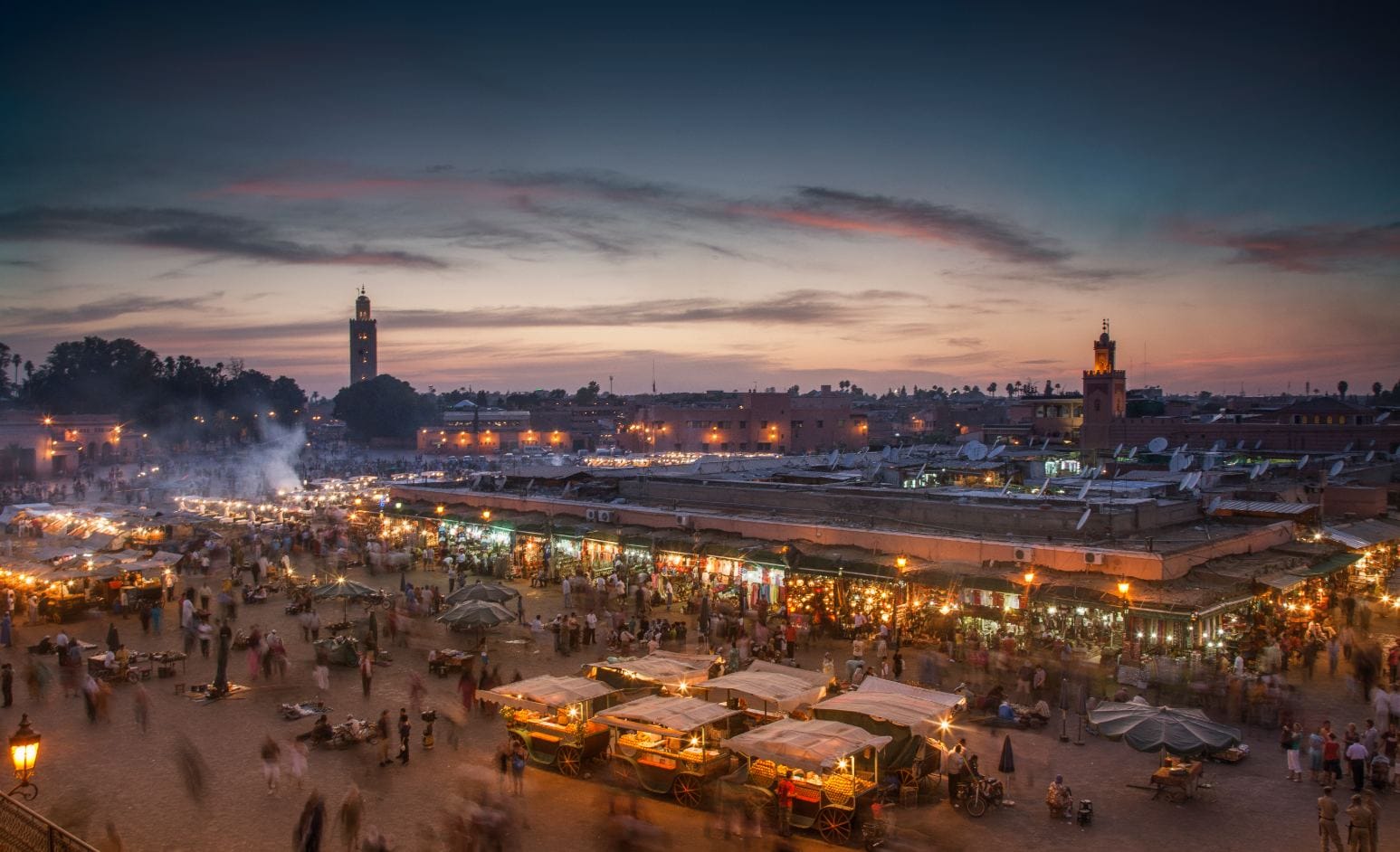
At the heart of it all is Jemaa el-Fna, the great square that transforms completely from morning to night. By day it is a market of storytellers, snake charmers, and orange juice vendors. By evening it becomes one of the most atmospheric outdoor gatherings on earth, with dozens of food stalls, musicians, and the minaret of the Koutoubia Mosque rising above the smoke.
Beyond the square, spend time in the Majorelle Garden, the Ben Youssef Madrasa, the leather tanneries of the medina, and the beautiful Saadian Tombs. Marrakech deserves at least two full days — more if you want to go at a relaxed pace.
Best for: First-time visitors, culture lovers, photography, family trips
2. Visit Fes and Its Ancient Medina
If Marrakech is Morocco’s most-visited city, Fes is its most profound. The medina of Fes el-Bali is widely regarded as the best-preserved medieval city in the Arab world — a living, functioning urban environment that has changed very little in a thousand years. Walking through it without a guide is both thrilling and disorienting, which is part of the experience.
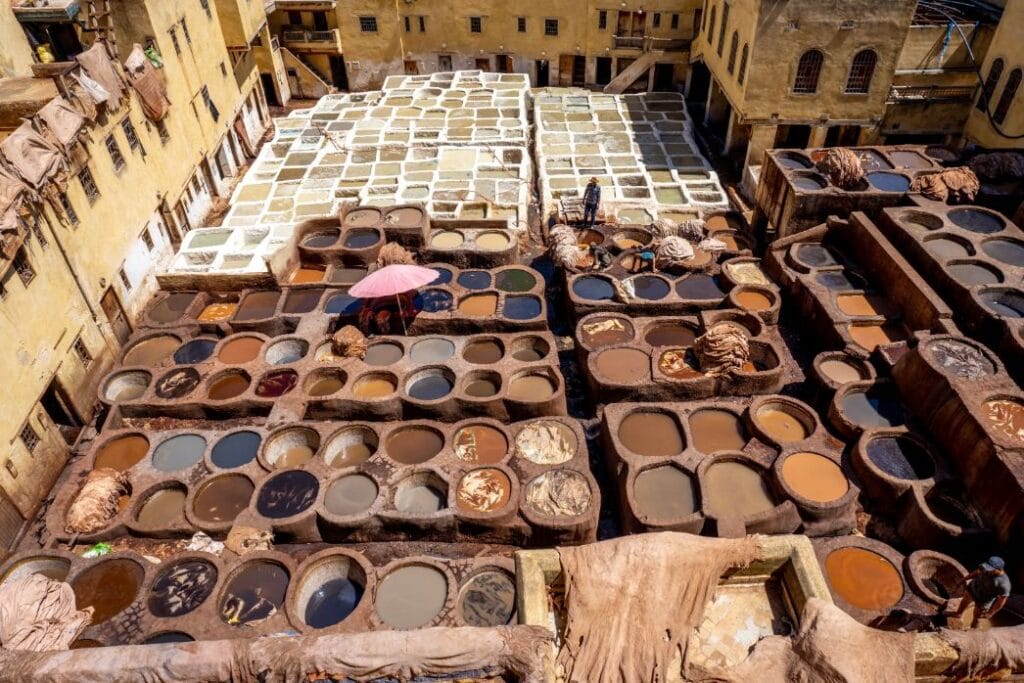
The highlights are many: the Al-Qarawiyyin University, founded in 859 AD and considered the world’s oldest continuously operating educational institution; the Bou Inania Madrasa with its intricate zellij tilework and carved cedar ceilings; and the famous Chouara Tannery, best viewed from the leather shop terraces above, where workers still dye hides in stone vats using age-old methods.
Fes rewards travellers who move slowly. Stay for two nights if possible — once to get lost, once to find what you missed.
Best for: History enthusiasts, architecture lovers, cultural immersion, independent travellers
3. Spend a Night in the Sahara Desert
If there is one experience that defines a Morocco journey for most first-time visitors, it is sleeping in the Sahara Desert. The Erg Chebbi dunes near Merzouga — some reaching 150 metres — are among the most beautiful in North Africa, and the experience of watching the sun drop behind them in silence is genuinely moving.
A typical desert stay involves arriving by camel or 4×4 at a luxury camp hidden among the dunes, sharing a candlelit dinner under the stars, and waking before dawn to watch the light change the colour of the sand from silver to gold. On clear nights, the Milky Way is visible in full.
This is not simply a tourist attraction — it is a genuine encounter with a landscape of extraordinary scale and beauty. Plan to spend at least one full night in the desert, and ideally two.
Best for: Couples, honeymooners, adventure seekers, photographers, bucket-list experiences
4. Visit Ait Ben Haddou and Ouarzazatet
The ksar of Ait Ben Haddou is one of Morocco’s most striking sights — a fortified earthen village rising from the floor of a dry riverbed, its towers and terraces glowing amber in the afternoon light. A UNESCO World Heritage Site, it served as a stopping point on the ancient trans-Saharan caravan route and has appeared in dozens of major films, from Lawrence of Arabia to Game of Thrones.
Nearby Ouarzazate — often called the “Door of the Desert” — is the gateway to the Draa Valley and the southern Moroccan kasbahs. The Atlas Film Studios here are the largest in the world and offer fascinating guided tours. The city itself is a practical and comfortable base for exploring the deep south.
Together, Ait Ben Haddou and Ouarzazate form a natural stop on any Marrakech-to-desert road trip, and the drive through the High Atlas via the Tizi n’Tichka pass is one of the most scenic in Morocco.
Best for: History buffs, film enthusiasts, road trip itineraries, photographers
5. Discover Chefchaouen, the Blue City
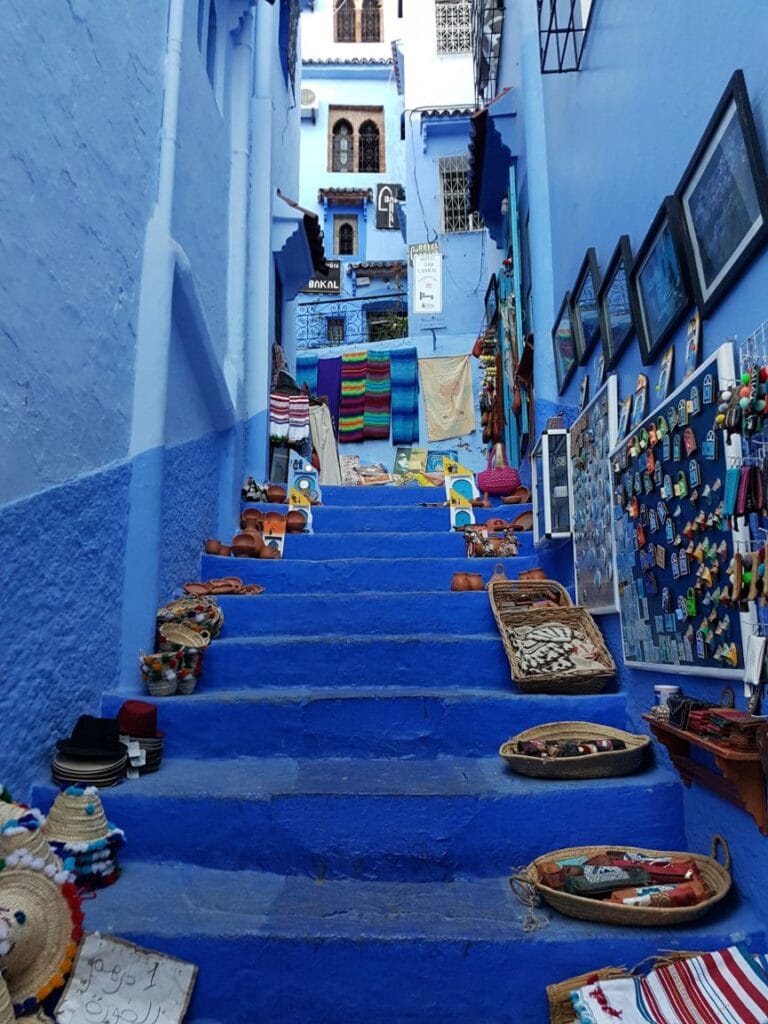
Tucked into the folds of the Rif Mountains in northern Morocco, Chefchaouen is one of the most photographed towns in all of Africa — and for good reason. The medina is painted almost entirely in shades of blue, from pale sky blue to deep cobalt, and the effect when walking its stepped lanes is quietly magical.
Beyond the Instagram appeal, Chefchaouen is a genuinely pleasant place to spend a day or two. The town has a relaxed, slightly bohemian atmosphere that sets it apart from the busier imperial cities. The Kasbah Museum in the main square is worth an hour of your time, and the surrounding Rif mountains offer short hikes with views over the rooftops.
Chefchaouen is most comfortably combined with a visit to Fes or Tangier as part of a northern Morocco circuit. It is best explored in the morning, before the heat and day-trippers arrive.
Best for: Photographers, solo travellers, couples, those combining with a northern Morocco tour
6. Ride Camels in Merzouga or Chegaga
Camel riding in the Sahara is one of those experiences that sounds like a cliché until you are actually doing it — perched above the sand as the sun rises, the silence broken only by the soft thud of camel hooves. It is slow, gentle, and unexpectedly meditative.
The two main areas for camel treks in Morocco are Merzouga in the south-east, home to the spectacular Erg Chebbi dunes, and Chegaga in the south-west, a more remote and less-visited desert area that appeals to travellers seeking solitude. Both offer camel rides of varying lengths, from a one-hour sunset ride to multi-day treks with overnight camps.
For families with children, camel rides in Merzouga are particularly popular and can be arranged as short excursions from a desert camp. For those wanting a more adventurous desert experience, Chegaga — reached by piste or 4×4 — offers dunes and silence that feel genuinely off the beaten track.
Best for: Families, adventure travellers, photography, desert immersion
7. Travel Through the Atlas Mountains
The High Atlas Mountains form the backbone of Morocco, running diagonally across the country from the Algerian border in the north-east to the Atlantic near Agadir in the south-west. For first-time visitors, even a brief foray into this landscape — whether by road, on foot, or by mule — offers a completely different side of Morocco from the medinas and deserts.
The most accessible Atlas experience from Marrakech is the Ourika Valley, about an hour south of the city, where Berber villages cling to the hillsides above a fast-moving river. More adventurous travellers might opt for a guided day hike in the Toubkal National Park, home to Jebel Toubkal — at 4,167 metres, the highest peak in North Africa.
For road trippers, the route over the Tizi n’Tichka pass (2,260m) to Ouarzazate is one of Morocco’s great drives, winding through terraced hillside villages and broad mountain plateaus with genuinely spectacular views.
Best for: Hikers, nature lovers, road trippers, travellers combining Marrakech and the south
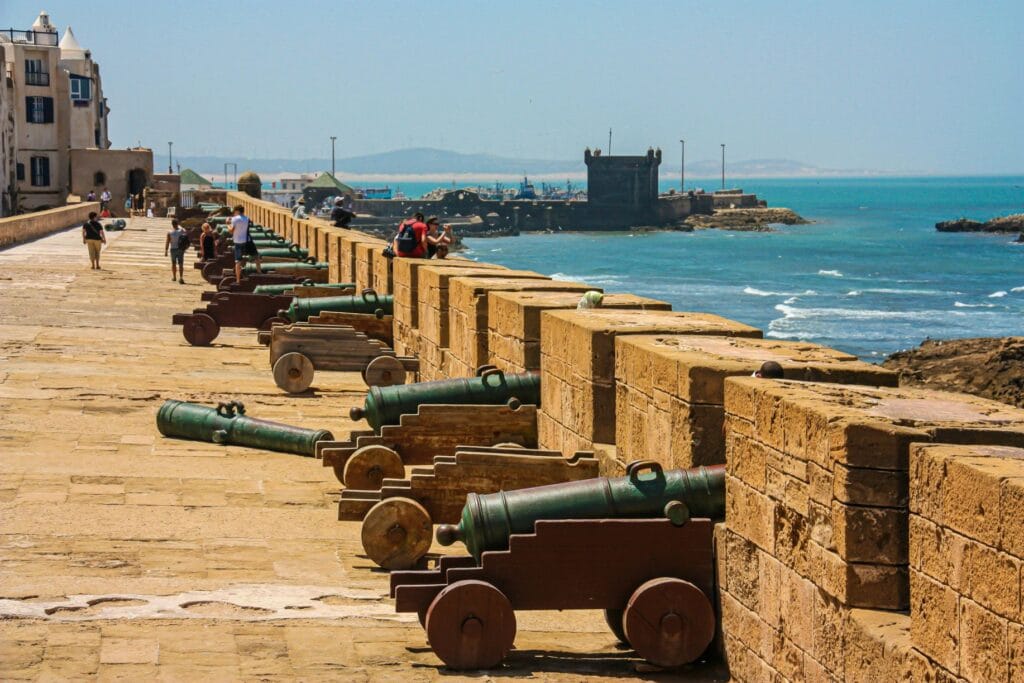
8. Explore Essaouira on the Atlantic Coast
Essaouira is the kind of place that surprises people who arrive expecting a beach town and find instead a walled port city with a 500-year history, world-class seafood, and a creative, free-spirited energy that has been attracting artists and musicians for decades.
The medina is compact, whitewashed, and genuinely beautiful — a blue-shuttered UNESCO World Heritage Site that feels uncrowded compared to Marrakech or Fes. The ramparts offer views over the Atlantic breakers and the blue fishing boats below. The port itself is lively in the morning when the catch comes in, and the wood-carvers’ souks are among the finest craft markets in Morocco.
Essaouira is also one of the world’s top windsurfing and kitesurfing destinations, thanks to the reliable Atlantic trade winds known locally as the alizé. Whether you come to surf, to eat grilled fish by the harbour, or simply to walk the ramparts at dusk, this city invariably earns a second visit.
Best for: Couples, surfers and watersports enthusiasts, foodies, those wanting a break from medina intensity
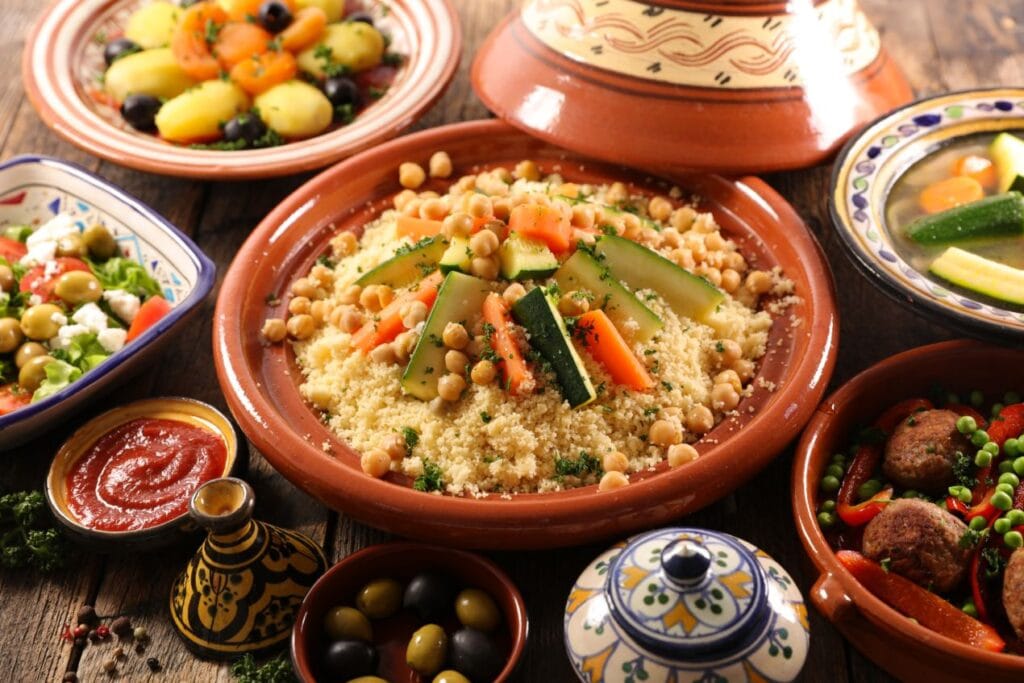
9. Taste Moroccan Food and Local Cuisine
Moroccan food is one of the great underrated cuisines of the world — complex, aromatic, deeply satisfying, and rooted in a culinary tradition shaped by Berber, Arab, Andalusian, and Jewish influences. Eating well in Morocco is not difficult; eating exceptionally well requires only curiosity and a willingness to go where locals go.
The essentials are well known: a slow-cooked tagine of lamb and prunes; a golden-crusted pastilla filled with pigeon or chicken and almonds; a proper harira soup thick with tomatoes, lentils, and herbs; and couscous as it should be — light, fluffy, and served on Fridays. Street food is equally rewarding: bissara (a fava bean soup eaten for breakfast), freshly fried sfenj doughnuts, and the brochettes you will find grilling over charcoal in any medina at dusk.
For first-time visitors, a cooking class in Marrakech or Fes is one of the best investments of a morning. You will visit the souk to buy ingredients with a local cook, learn the fundamentals of spice blending and slow cooking, and sit down to eat what you have made. It is one of the most intimate ways to connect with Moroccan culture.
Best for: Foodies, families, cultural immersion, travellers who want to bring Morocco home with them
10. Take a Private Multi-Day Morocco Tour
Morocco rewards travellers who plan carefully — and penalises those who do not. The country is large, the distances between highlights are significant, and the best experiences (a sunrise in the Sahara, a private dinner in a riad, a guided walk through the medina with a local historian) rarely happen by accident.
A private multi-day Morocco tour solves this entirely. Rather than fitting your trip around fixed group departure dates, a private itinerary is built around your travel dates, your interests, and your pace. You move with a dedicated driver-guide, stay in handpicked riads and desert camps, and spend your time seeing Morocco rather than waiting for it.
For first-time visitors, a classic 8- to 10-day private circuit typically combines Marrakech, the High Atlas, Ait Ben Haddou, Merzouga and the Sahara, the Draa Valley, and a final night back in Marrakech or a transfer to Casablanca. With more time, Fes, Chefchaouen, and the coast can be added. Morocco Extra Tours specialises in designing exactly these kinds of private, tailor-made itineraries — from short city breaks to comprehensive cross-country journeys.
Best for: Couples, families, first-time visitors, travellers who value flexibility and local expertise
TOP EXPERIENCES AT A GLANCE
Here is a quick guide to the best Morocco experiences for first-time visitors, from historic cities and Sahara Desert adventures to mountains, coast, food, and private tours.
| Category | Best Choice |
|---|---|
| Best cultural experience | Exploring the medinas of Marrakech and Fes |
| Best desert experience | One or two nights in the Sahara near Merzouga (Erg Chebbi) |
| Best city for history | Fes — home to the world’s oldest medina and university |
| Best coastal escape | Essaouira — walled Atlantic port with great food and wind |
| Best mountain experience | Tizi n’Tichka pass drive or Ourika Valley hiking near Marrakech |
| Best first-time itinerary | 8–10 days: Marrakech → Atlas → Ait Ben Haddou → Sahara → Fes |
| Best private tour option | Morocco Extra Tours tailor-made private circuits |
Tips for Planning Your First Morocco Trip
Best time to visit The most comfortable months to travel in Morocco are March to May and September to November. Spring brings wildflowers to the Atlas valleys and pleasant temperatures across the country. Autumn is ideal for the desert — hot days, cool nights, and long golden evenings. July and August are very hot in the interior, while December to February can be cold in the mountains and the desert at night.
How many days to spend A minimum of seven days allows you to cover Marrakech, a desert trip to Merzouga, and one or two stops along the way. Ten to twelve days is the sweet spot for a more complete experience that includes Fes, Chefchaouen, or the Atlantic coast. Morocco is not a country to rush.
Private tours vs group tours Group tours are budget-friendly but inflexible — you move at someone else’s pace and spend a proportion of every day waiting. Private tours cost more but give you full control: your own vehicle, your own guide, your own schedule. For first-time visitors covering long distances, the difference in comfort and experience is significant.
Desert trip planning If the Sahara is on your list — and it should be — build at least two nights into the desert section of your trip. One night is enough to see the dunes; two nights allows you to experience the silence, the stars, and the early morning light properly. Book your desert camp in advance, especially in spring and autumn.
Clothing and packing Morocco is a conservative Muslim country, and while cities like Marrakech are accustomed to international visitors, modest dress is both respectful and practical. Light, breathable layers work well for the medinas; warm layers are essential for the desert at night and the Atlas in any season. Good walking shoes are non-negotiable in any medina.
Local guides An official local guide in Fes or Marrakech is worth the cost, particularly in the medinas where unlicensed “guides” are persistent and navigation is genuinely difficult. Morocco Extra Tours works exclusively with certified, English-speaking guides who know their cities deeply.
Travel pace Morocco is best explored slowly. The souks, the riads, the kasbahs — these are not places to tick off a list. Leave room in your itinerary for a long lunch, an unplanned conversation, a side street you weren’t expecting. The best Morocco moments rarely appear in any guidebook.
Local advice: If this is your first time in Morocco, don’t try to see everything in one short trip. Choose a balanced route that includes one imperial city, one desert experience, one mountain or valley route, and enough time to enjoy the medinas without rushing.
Ready to Plan Your Morocco Trip?
Tell us your travel dates, arrival city, and travel style. Morocco Extra Tours can help you create a private Morocco itinerary that includes the best places and experiences for your first visit — from the medinas of Marrakech and Fes to the dunes of the Sahara and the coast of Essaouira.